By the MR Event Planner production team · Updated 21 November 2026 · Reading time about 7 minutes
Quick answer
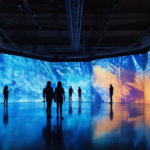
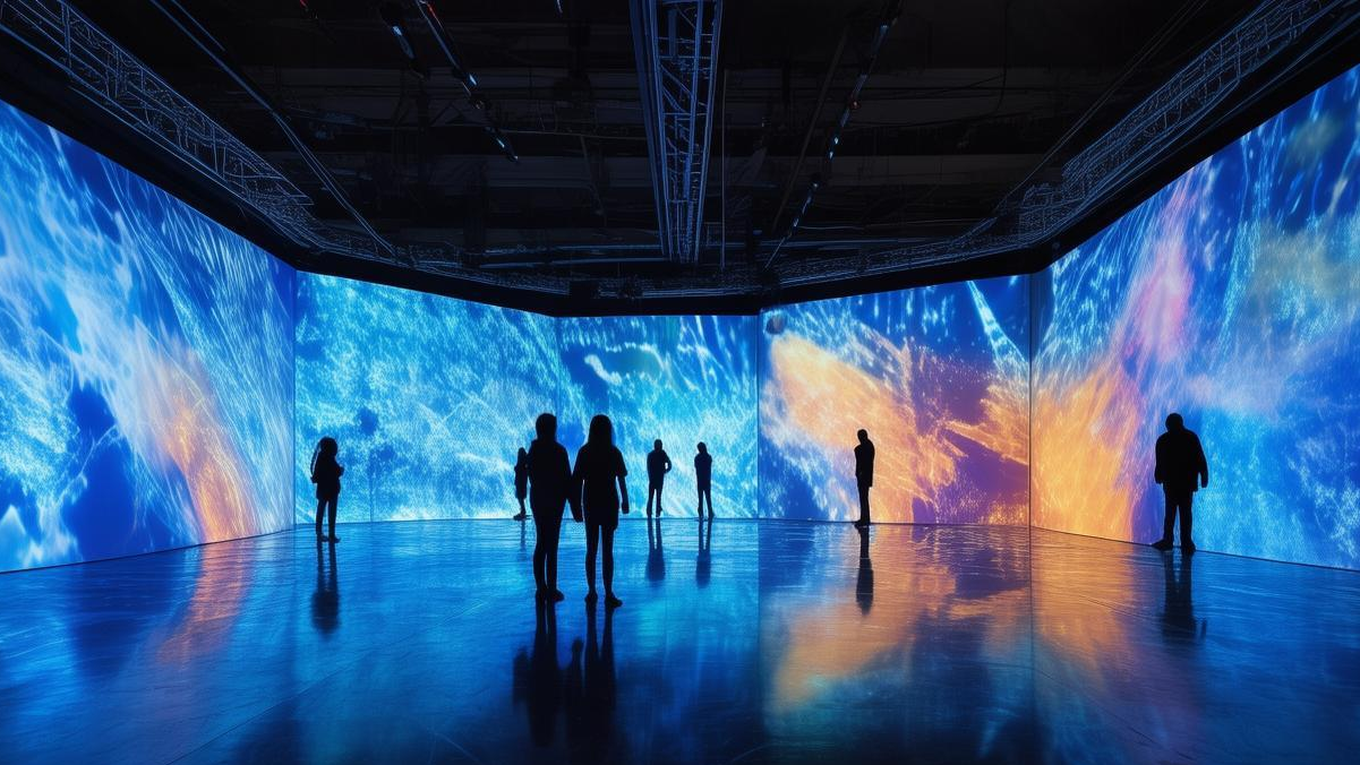
An immersive projection room surrounds visitors with light on several surfaces at once. It works when walls, ceiling and floor are calibrated as one continuous canvas, with brightness matched per surface and content designed to loop without a visible seam.
A room only feels immersive when the eye stops finding edges. Four projectors aimed at four walls will still read as four walls if the corners are brighter, the floor is dim, and the loop restarts with a visible cut.
This article explains how these rooms are engineered in Hong Kong: how surfaces are chosen, how many projectors a room actually needs, why the floor is the problem child, and how much site time calibration takes. It is written from the production side, for clients planning a showroom, a launch, a gallery or a brand experience.
Key takeaways
- Immersive coverage means walls, ceiling and floor treated as one calibrated canvas, not three separate shows.
- Projector count follows surface area and target lux; a 15,000-lumen laser unit covers roughly 100 m² at 150 lux in controlled light.
- Floor projection needs the brightest output because ambient light, spill from walls and foot traffic all eat contrast.
- Corners must be blended and masked, otherwise the room reads as panels and the illusion fails.
- Budget two full days on site for a four-surface room: one to build and rough-align, one to calibrate and rehearse the loop.
What makes a projection room feel immersive rather than just decorated?
It is continuity. Immersion comes from the audience being unable to locate the boundary between surfaces, so the eye accepts the room as a single environment rather than a set of screens.
Continuity is created in three places. Geometry: every projector is warped to the real surface, so lines stay straight across corners. Brightness: the luminance of wall, ceiling and floor is matched at the seam, which usually means the floor runs brighter than the wall. Motion: content is authored to travel across surfaces, so a slow drift of light passes from wall to ceiling instead of stopping at the join.
Rooms that fail usually fail on the third point. The hardware is fine and the alignment is acceptable, but the content was built as separate clips, so the seams return the moment the loop plays. We plan content and rigging together for that reason, the same way a facade show is designed inside a survey model rather than beside it.
How many projectors does an immersive projection room need?
The count comes from area and target brightness, not from the number of walls. Required lumens equals target lux multiplied by surface area, divided by screen gain, which is about 1.0 on most matte event surfaces.
For a controlled indoor room, 100 to 150 lux reads as a saturated image. A single 15,000-lumen laser projector therefore covers roughly 100 m² at 150 lux. A room with 200 m² of wall, ceiling and floor needs at least two projectors before overlap, and in practice three or four, because blended zones and short-throw corner work both consume coverage.
Room height changes the plan more than people expect. A 6 m ceiling needs long-throw lenses mounted far back or high; a 3 m ceiling forces ultra-short-throw units close to the surface, which multiplies the projector count for the same area. The lumen calculation is the same arithmetic at any scale, but the lens choice is decided by the room.
| Room type | Typical surface area | Target lux | Rough projector count |
|---|---|---|---|
| Small showroom, 3 walls | 60–90 m² | 100 | 1–2 units |
| Gallery room, 3 walls + ceiling | 150–200 m² | 120 | 3–4 units |
| Full box, 4 walls + ceiling + floor | 250–350 m² | 150 | 5–7 units |
| Large hall with floor traffic | 400 m² and above | 180–250 | 8 units and above |
Why is the floor the hardest surface in an immersive room?
Because the floor loses contrast from every direction at once. Overhead lighting spills onto it, wall projection bleeds across it, and every visitor walking through it blocks part of the beam and drags shadow across the image.
Three fixes matter. First, run the floor brighter than the walls, typically 30 to 50 percent above wall level, so it holds up under ambient light. Second, kill or dim the house lighting over the floor zone; a room that is lit for safety will never look immersive. Third, place projectors so the beam arrives at a steep angle from above, which shortens shadows cast by people.
Foot traffic also decides the surface. Glossy floors give a strong reflection and a doubled image, matte floors give a softer, more even result. If the floor has to carry staging loads, the projection surface must be a separate sacrificial layer, because a painted deck under a 500 kg truss tower will not survive the build.
How do you blend corners so the room reads as one image?
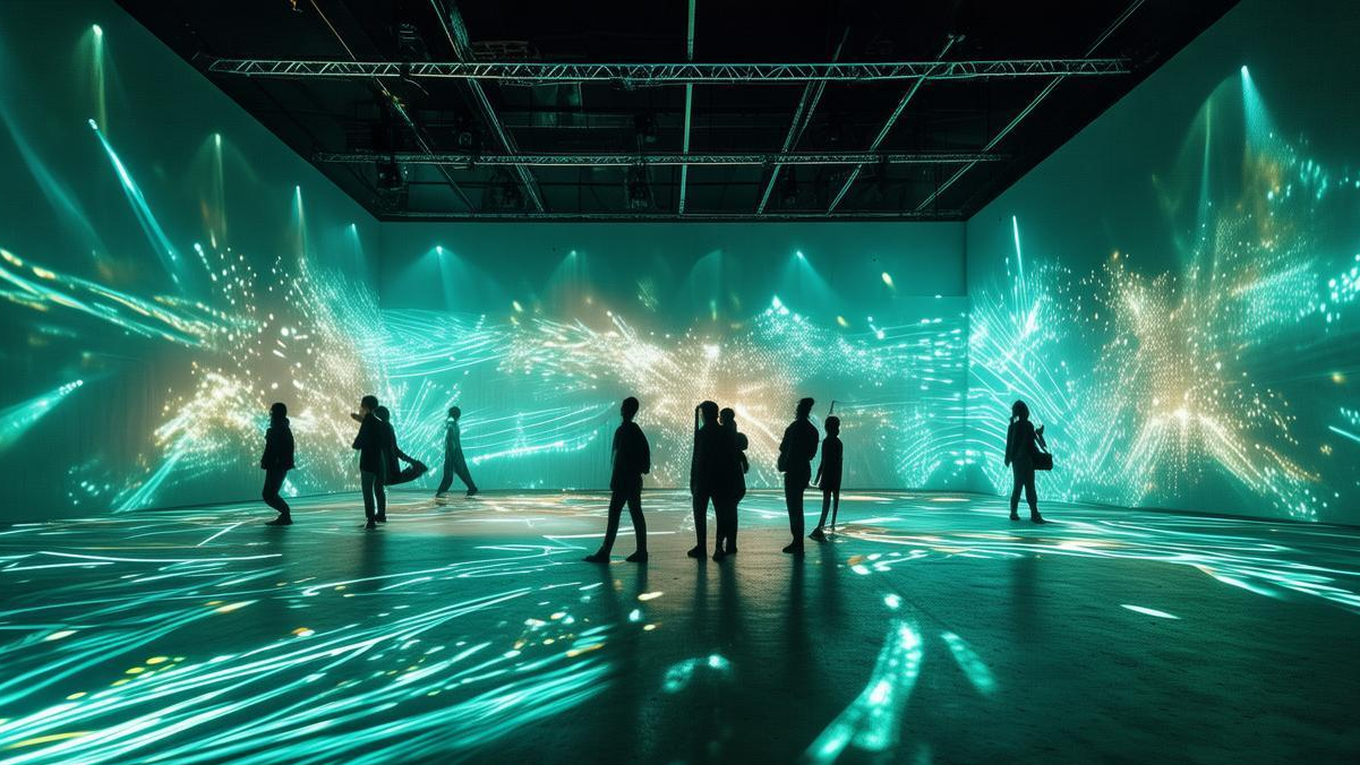
Corners are handled with a combination of edge blending, geometric warping and a soft mask, and the order matters.
Each projector is first warped so its rectangle lands correctly on the physical surface, including any tilt or recess. Adjacent projectors are then given overlapping edges, and the overlap region is blended with a gradient so the two beams add up to a single brightness level instead of a bright stripe. Finally a mask trims spill where the beam hits a door frame, a column or an area the client does not want lit.
The failure mode is a corner that is geometrically perfect but photometrically wrong: the lines join but the seam glows. That is a blending curve problem, not a lens problem, and it is why the edge blending pass gets its own slot on site.
How is ceiling projection different from wall projection?
Ceiling work changes the mounting logic. Projectors are usually flown on truss, aimed upward or across at a steep angle, and the useful throw distance is short, which pushes the specification toward short-throw lenses or mirror-based mounts.
It also changes content design. A ceiling is read while looking up and moving, so detail must be larger and slower than wall content. Fast cuts and fine type are wasted overhead, a fact clients rarely accept until they stand in the room.
Service access is the constraint that catches projects late. A projector flown above a finished ceiling needs a safe way to be reached for focus and lamp service, and a room that has been dressed for photography often has none. We confirm the access route before the rigging plan is signed, not after.
What content works best for a looping immersive room?
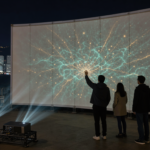
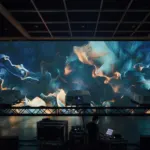
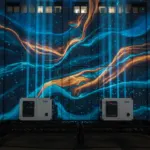
Content that drifts. Slow gradients, particle fields, generative line work, weather and water, abstract architectural forms, and long camera moves that cross surfaces deliberately all loop without announcing the restart.
Three practical rules. Keep the loop long, ideally five minutes or more, so visitors who stay for two minutes never see the seam. Author it in the room’s native resolution and aspect, not in 16:9 and then stretched. And build in a low-detail recovery zone, a calm passage of the loop, so the playback system can resync without a visible jump.
Where the room carries brand content, keep it in the middle third of the loop and let the abstract passages carry the transitions, so the show can run all day without a visible restart.
How long does it take to calibrate an immersive room in Hong Kong?
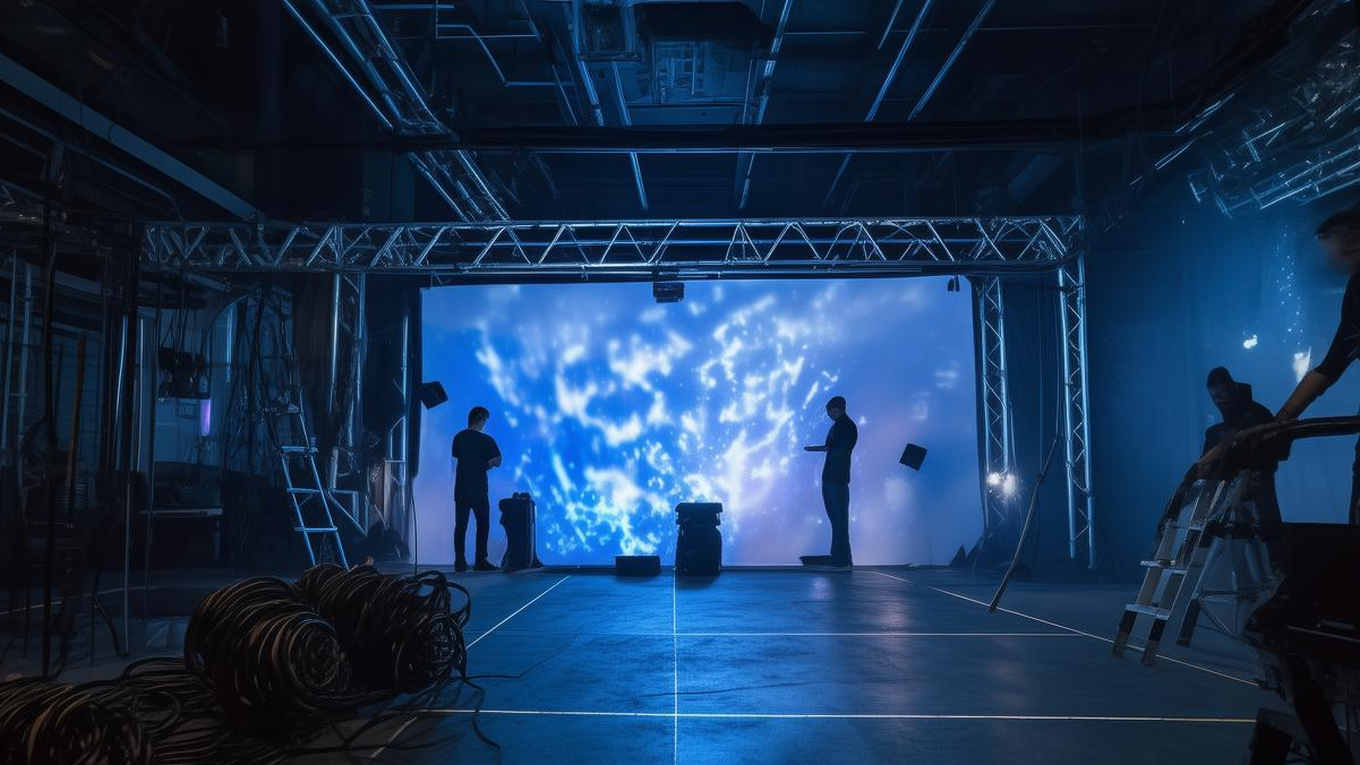
For a four-surface room, plan two full days on site: one to rig, cable and rough-align, one to calibrate, colour-match and rehearse the loop. A single-wall showroom can be done in a day if the room is empty and the ceiling is accessible.
Calibration itself is the slow part, because every projector pair needs a blend curve, and every surface transition needs a brightness match that survives the actual house lighting. Haze, dust and air conditioning all shift the result slightly, so the final pass happens with the room lit exactly as it will be during the event.
Hong Kong venues add their own friction. Loading access, lift bookings and after-hours build windows compress the schedule, so a room that is only free from 22:00 needs its alignment plan written before the truck arrives. If you are comparing options, start from what the room needs to look like and work backward to the equipment list.
What does an immersive projection room cost to build in Hong Kong?
There is no single figure, because the cost driver is surface area and site time rather than the number of projectors. The ranges below are for planning only and move with model, venue access and build hours.
Projector hire runs roughly HK$2,000 to HK$3,000 per unit per day depending on model and brightness. Media servers, playback and show control are quoted per project. Technicians are typically HK$2,000 to HK$3,000 per person per day, and a multi-surface room needs at least two on site through calibration. Truss and rigging sit around HK$150 to HK$250 per metre, and transport in Hong Kong commonly lands between HK$2,000 and HK$5,000 depending on distance and load.
The variable that surprises clients is content. A five-minute loop designed for a specific room geometry is a production job in its own right, and usually a larger line item than the hardware. Where a fixed installation uses LED surfaces instead of projection, our LED product is P2.84 and is specified per square metre per day for rental.
Frequently asked questions
How many projectors do I need for an immersive projection room?
It depends on surface area and target brightness rather than wall count. Using required lumens equals target lux times area divided by screen gain, a 15,000-lumen laser projector covers about 100 m² at 150 lux, so a 250 to 350 m² room with walls, ceiling and floor typically needs five to seven units once blending overlap and corner coverage are allowed for.
Can you project onto a floor that people walk on?
Yes, and it is common in immersive rooms. The floor is projected from steep overhead angles and run brighter than the walls, typically 30 to 50 percent higher, so the image holds up under ambient light and foot traffic. House lighting over the floor zone usually has to be dimmed or switched off.
Why do the corners of my projection room look like separate panels?
Usually because the projectors are geometrically aligned but not photometrically blended. The overlap zone needs a gradient blending curve so the two beams add to a single brightness level, plus a mask to trim spill onto columns and door frames. Seams that glow are a blend curve issue, not a lens issue.
How long does it take to set up an immersive projection room in Hong Kong?
A four-surface room typically needs two full days on site, one for rigging, cabling and rough alignment, and one for calibration, colour matching and loop rehearsal. A single-wall showroom can be completed in one day if the room is empty and the ceiling is safely accessible.
What kind of content works best for a looping immersive room?
Slow, continuous material: gradients, particle fields, generative line work, water and weather, and long camera moves that cross from wall to ceiling. Loops of five minutes or more avoid a visible restart, and a calm low-detail passage in the loop gives playback room to resync.
How much does it cost to rent projectors for an immersive room in Hong Kong?
Projector hire is roughly HK$2,000 to HK$3,000 per unit per day depending on model and brightness, with technicians around HK$2,000 to HK$3,000 per person per day, truss and rigging around HK$150 to HK$250 per metre, and local transport commonly HK$2,000 to HK$5,000. Content production and media servers are quoted separately per project.