By the MR Event Planner production team · Updated 24 October 2026 · Reading time about 7 minutes
Quick answer
Projection mapping at a corporate event works when the surface is chosen before the creative, the content is locked at least seven working days out, and a full technical rehearsal happens on the real stage. The show is engineered around the venue’s rigging points, ambient light and load-in window.
A product launch gives a brand about four minutes to make a room feel like an event rather than a presentation. Projection mapping changes the architecture of that room without building anything permanent: a wall becomes a machine, a set piece opens up on cue.
It is also easy to get wrong. Corporate timelines compress, content arrives late, the venue hands over the room at 6pm, and a show that needed three hours of alignment gets forty minutes. The result is a crooked image with visible blend seams, which is worse than no mapping at all.
This guide covers how we plan projection mapping for corporate events and launches in Hong Kong: the surface, the projection-versus-LED decision, stage integration, the content calendar, the rehearsal window and the on-site crew.
Key takeaways
- Choose the projection surface before approving the creative. A flat wall, a set piece with a built-in mask and a curved scenic surround are three different engineering briefs.
- Projection wins where the surface is architectural and the room can be darkened. LED wins where ambient light is high or the show must travel between venues.
- Content lock should sit at least seven working days before the event; a mapped show cannot absorb a logo change on launch morning.
- Budget one full rehearsal on the actual stage with the actual content, timecode and audio.
- Crew is not one person with a laptop: expect a projectionist, a media server operator and a technician per projector cluster.
What does projection mapping actually add to a corporate event?
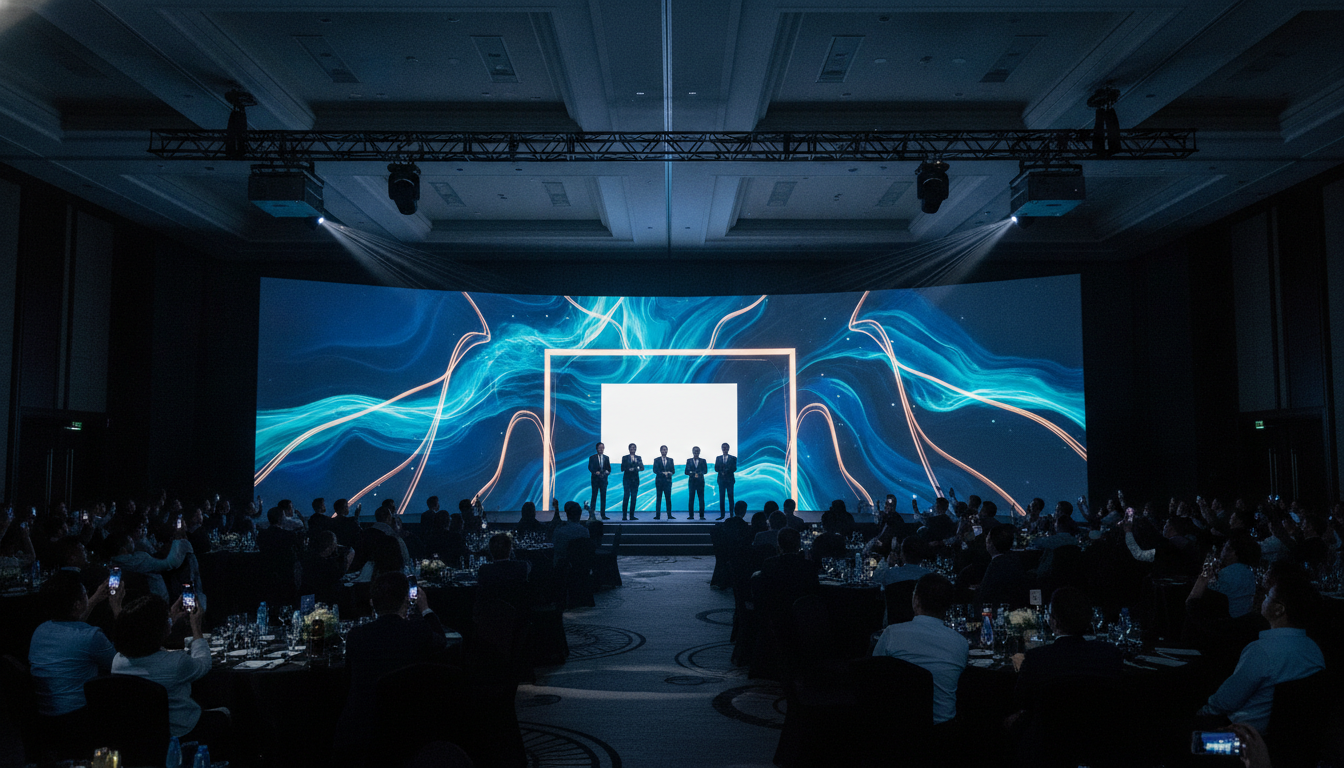
Projection mapping turns an existing surface into a controllable display, so the room becomes part of the storytelling instead of a backdrop behind it. A reveal can happen on the set rather than on a screen, and a gala can change its visual identity between courses without a scene change.
The practical advantage over a conventional screen is scale and integration. A 12-metre scenic wall can be mapped edge to edge, with artwork following the physical shape of the set: a reveal panel, a product plinth, a logo cut-out. Because the image is projected rather than built, one set can carry four looks across an evening.
The disadvantage is that everything is conditional. Projection needs darkness, a surface, a beam path and alignment time. Those four conditions are the whole planning problem. Our projection mapping service works on the rule that creative is signed off only after the room has been surveyed.
Should a corporate event use projection or an LED wall?
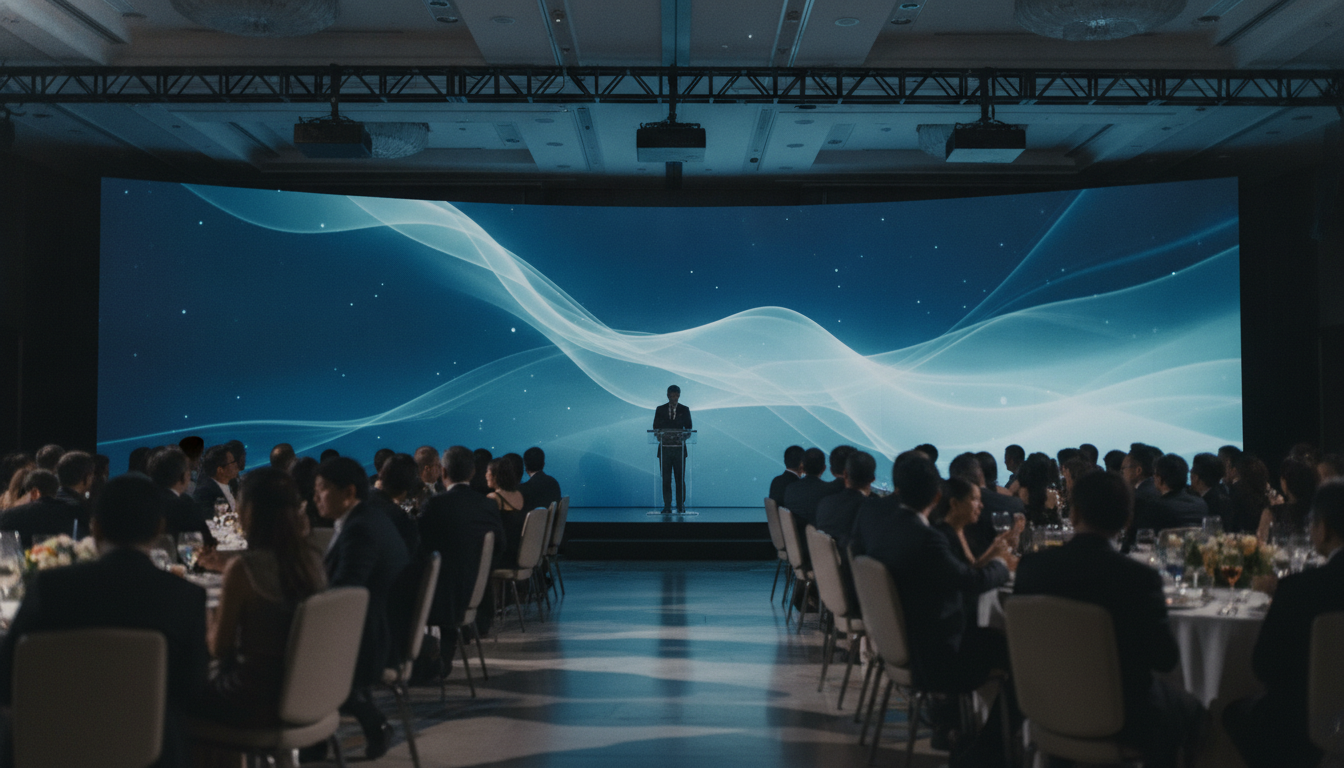
Use projection when the surface is architectural, the room can be dimmed, and the creative benefits from an edge-to-edge image that follows the set. Use an LED wall when the room is bright, the content must be crisp on camera, or there is no usable wall and no dark control.
The decision usually comes down to ambient light, surface availability, camera work and budget. A live-streamed launch holds contrast on LED in a way projection cannot match; a seated gala in a darkened ballroom gets far more image per dollar from projection on a large surface.
There is a middle path corporate clients often miss: map onto a set piece and use a small LED wall for content that must stay legible, such as product names and speaker lower-thirds. Splitting the visual job is usually cheaper than forcing one technology to do everything.
Our LED wall stock is P2.84, which reads cleanly at typical ballroom viewing distances and holds up on camera. Projector rental for event work generally sits around HK$2,000–3,000 per unit per day depending on model and lens, with laser units at the upper end.
| Factor | Projection mapping | LED wall (P2.84) | Typical corporate use |
|---|---|---|---|
| Ambient light tolerance | Low to moderate; needs dimming | High; readable under show lighting | LED for daytime or broadcast-led events |
| Surface requirement | Needs a wall, set piece or scenic panel | None; freestanding | Projection where the venue already has a good wall |
| Image shape | Follows the architecture, including irregular edges | Rectangular modules | Projection for reveals and scenic integration |
| On-camera performance | Good in a dark room, can band on camera | Consistent, high contrast | LED for livestream and social cutdowns |
| Build and strike time | Rigging plus 2–4 hours alignment | Fast modular build, short calibration | LED where load-in is tight |
How is projection integrated with the stage set?
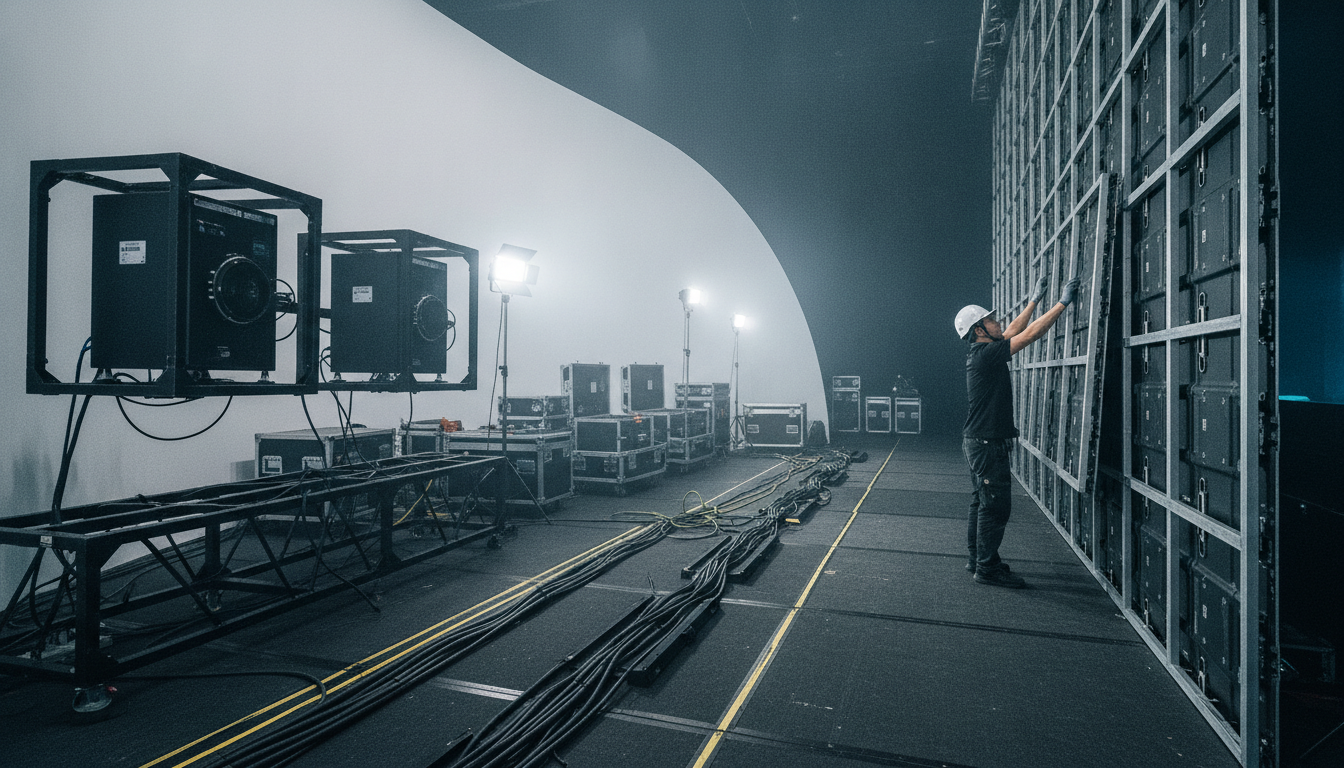
Integration is decided on paper before anything is built. The set designer, lighting designer and projection team agree early on which planes carry image, which must stay matte and unlit, and where projectors can sit without being seen or blocking a sightline.
The common mistake is treating the set as finished before deciding where the projector goes. A curved scenic surround needs a position far enough back to cover the full arc without severe keystone, which may mean giving up front-row seating or moving the stage forward. That is cheap to decide in week one and expensive on load-in day.
Dark zones are planned deliberately. A matte black plinth in front of a lit wall reads as a silhouette; a glossy or white plinth catches spill light and turns into a grey rectangle. Material choice on the set is part of the projection design.
Physical reveals have to be shared. The projection operator, stage manager and automation team work to the same timecode, and that cue is rehearsed until it is boring. A reveal that lands half a second early looks like a mistake.
- Projection planes agreed with the set designer before fabrication
- Matte finishes on any surface that must stay dark
- Projector positions validated against sightlines and front-row seating
What content deadlines should a corporate client plan for?
Content lock should be at least seven working days before the event, and ten is comfortable for anything with a product reveal. Mapped content is not a slide deck: it is built to a specific canvas, masked to specific shapes and timed to specific cues, so a late change is a rebuild of the affected scenes.
The schedule that works backwards from a launch date: four to six weeks out, creative concept and surface confirmed. Three to four weeks out, storyboard and animatic approved with the reveal blocked in. Two weeks out, first full render reviewed on a calibrated monitor. Seven working days out, final lock on content, audio mix and cue list.
After lock, only two kinds of change are realistic: colour and brightness trims, and cue timing. Anything structural should be quoted as a change rather than absorbed on site. Clients who accept this get a better show, because the last week is spent testing instead of rebuilding.
One more item belongs on the calendar: the fallback. Every mapped show should have a static master that can play if a projector or media server fails, so the launch continues on a single clean image.
How much rehearsal time does a mapped launch need?
A mid-size corporate launch needs at least one full technical rehearsal on the actual stage with the actual content and audio, plus a second run for the client to watch. Two hours is the floor for a single-surface show; a multi-surface show with a reveal and a live camera feed needs four.
Rehearsal is where the survey model meets the real room: corner alignment, blend curves between overlapping projectors, colour matching across units, and the discovery that house lighting leaves a hotspot nobody accounted for. All of it must happen before executives walk the stage, because from then on the room belongs to guests.
Load-in sequencing matters as much as the hours. Projectors go up after the truss is flown and before scenic finishes, or the crew ends up working around the set. Networking and media servers are commissioned while lighting is still focusing. The mapping team then gets the room for the alignment block.
Where the venue will not give a full evening, we ask for a morning access slot on the event day and run a compressed rehearsal with the client watching on a monitor. That works, but it removes the option of changing the creative.
What crew and equipment sits on site?
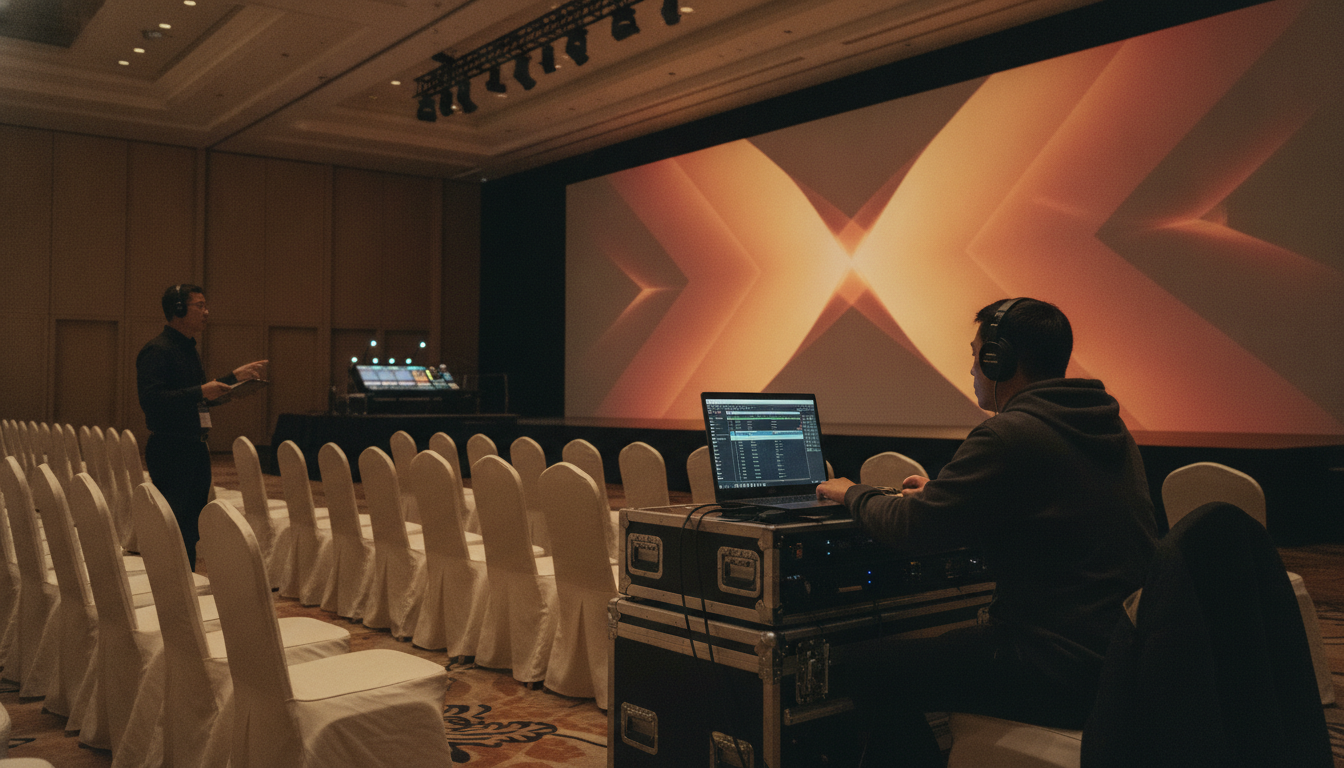
For a single-surface show with two to four projectors, expect a projectionist or media server operator, one technician per projector cluster, and a rigger for the truss work. On top sit the usual roles: stage manager, lighting operator, audio engineer and a technical director who owns the cue calls.
Equipment scales with surface area and redundancy, not with the number of scenes. A launch that cannot afford a blackout needs a hot-spare projector and a second media server on the same network, already aligned. That redundancy is the first line clients try to cut and the first they are grateful for.
Power is planned per cluster rather than per projector. Projector stacks, media servers and networking want a clean dedicated supply, and in older Hong Kong venues that often means a generator on the loading dock with its own fuel, noise and exhaust plan. Cables across ballroom carpets get matted and taped.
On the day, the crew works to a written cue list with times, not verbal instructions, so the show runs the same way at rehearsal, at the launch, and at the press showing an hour later.
What usually goes wrong, and how is it covered?
The four recurring failures are late content, an uncooperative surface, insufficient alignment time and no fallback. Each has a straightforward control: a lock date in the contract, a survey before creative approval, a load-in schedule agreed with the venue in writing, and a static master version of the show.
Late content is the most common and most expensive. When the final render arrives on the morning of the event, the alignment block becomes a rendering block and the show goes on stage untested. The fix is procedural: the client signs a content lock date alongside the production contract.
Surface problems appear late because nobody looked at the wall properly. Old paint, visible patch repairs, a glossy finish or a window grid all break an image in ways that projector output cannot fix. A survey in week one costs a fraction of a rework in week four.
Beyond that, the boring controls do the work: public liability insurance, a method statement for work at height, and a weather plan for anything outdoors. Outdoor activations follow the same logic as our guide to facade projection mapping in Hong Kong, where ambient light and neighbour sightlines dominate the design.
If you are still deciding how the visuals should carry the launch narrative, our portfolio shows mapped surfaces used across launches, galas and brand activations, including stages where projection and LED were combined.
Frequently asked questions
How much does projection mapping cost for a corporate event in Hong Kong?
Cost depends on surface area, projector count and class, rigging, content production and crew days. Projector rental for event work typically falls in the region of HK$2,000–3,000 per unit per day depending on model and lens, and content production is usually the largest single variable on a launch. Ask for a breakdown across equipment, labour, content and logistics so the lines can be compared.
Can projection mapping work in a brightly lit hotel ballroom?
Only with cooperation from the lighting design. Mapping needs the surface to be the brightest thing in frame, so house lights are dimmed or restricted to the audience area during mapped sequences. If the room must stay bright for camera or catering reasons, an LED wall is the more reliable choice.
How long does it take to set up projection mapping for a product launch?
A single-surface show with two to four projectors usually needs one build day for rigging and installation, then two to four hours of alignment and a technical rehearsal. Multi-surface shows with reveals or live camera feeds need two build days and a longer rehearsal block.
How many projectors do I need for a stage backdrop?
Total lumens required equals target lux multiplied by surface area, divided by screen gain. A 12-metre by 5-metre backdrop is 60 square metres; at 150 lux that is 9,000 lumens, which one 10,000–15,000 lumen laser projector can cover before allowing headroom for stage lighting and blend overlap.
Can you change the content after the rehearsal?
Colour, brightness and cue timing can be adjusted on site. Structural changes such as new scenes, a moved reveal or a different logo treatment should be treated as a quoted change, because rebuilding mapped scenes on load-in day puts the whole show at risk.
Do I need a backup if a projector fails during the launch?
Yes, for any show that cannot afford a visual blackout. A hot-spare projector already aligned to the same surface, plus a second media server on the same network, lets the show continue. A static master version of the content is the minimum fallback and costs almost nothing to prepare.
Send us the venue, the date and the surface you have in mind, and our production team will come back with a projector count, a stage integration outline and a content deadline calendar you can build the launch schedule around. Talk to our corporate projection team.