By the MR Event Planner production team · Updated 31 October 2026 · Reading time about 7 minutes
Quick answer
For projection mapping, required lumens equal target lux multiplied by surface area, divided by screen gain. A night facade at 150 lux over 100 square meters needs about 15,000 lumens. Raise the target for ambient light, then add 20 to 30 percent headroom.
A brightness plan is the least glamorous part of a projection mapping project, and it is the part that decides whether the show reads as a living surface or as a washed-out rectangle. Most of the under-performing jobs we are asked to rescue are not content problems. They are lumen problems.
The arithmetic is simple: lux on the surface, square meters of wall, gain of the material, ambient light in the scene, and the throw ratio of the lens. Get those five numbers right and the projector count follows. Skip them and you end up blending a third unit on site at two in the morning.
Everything below is a working range, not a quote. Final specification depends on the venue, the surface, the lens and the projector model, which is why we meter the wall before committing to a number. For the wider build sequence, see our projection mapping service page and the facade project breakdown.
Key takeaways
- Brightness is arithmetic: lumens = target lux x surface area / screen gain. Work in lux on the wall, not in projector spec sheets.
- 150 lux on a matte surface at gain 1.0 is a solid night-time target; a single 15,000-lumen laser unit covers roughly 100 square meters at that level.
- Ambient light is the biggest hidden variable. Meter the wall at the hour the show runs, with venue lighting at event level.
- Dark concrete and dark render sit around 0.4 to 0.6 gain, so the same projector delivers 40 to 60 percent of the light a white wall would return.
- A larger image is dimmer because the same lumens spread over more area; more distance with the same image size barely changes brightness.
- Adding projectors adds truss, blending, cabling and crew, so array cost scales faster than projector count.
How many lumens do you actually need for projection mapping?
You need enough lumens to hit a target illuminance on the surface, and that target is set by how much light is already in the scene. The formula is lumens = target lux multiplied by surface area in square meters, divided by screen gain. Work in lux, because lux is what the audience sees.
A 100 square meter wall at 150 lux on a matte surface at gain 1.0 needs 15,000 lumens, which is one current laser projector. Double the wall and you double the lumens, which is where arrays begin. Add the blend overlap between adjacent units, normally 10 to 15 percent of image width, and the count rises again.
The figures below are working targets for night conditions with controlled spill light. They already assume a matte surface near gain 1.0 and no allowance for headroom, so add the headroom afterwards.
| Surface area | Target lux | Lumens required | 15,000-lumen units | Typical scene |
|---|---|---|---|---|
| 30 m² | 200 lux | 6,000 | 1 | Indoor brand wall, dark room |
| 100 m² | 150 lux | 15,000 | 1 | Entrance feature, podium at night |
| 250 m² | 120 lux | 30,000 | 2 | Mid-rise side wall, stage backdrop |
| 500 m² | 100 lux | 50,000 | 4 | Venue frontage, pier shed |
| 1,000 m² | 80 lux | 80,000 | 6 | Landmark facade, multi-storey wall |
Why does ambient light change the answer so much?
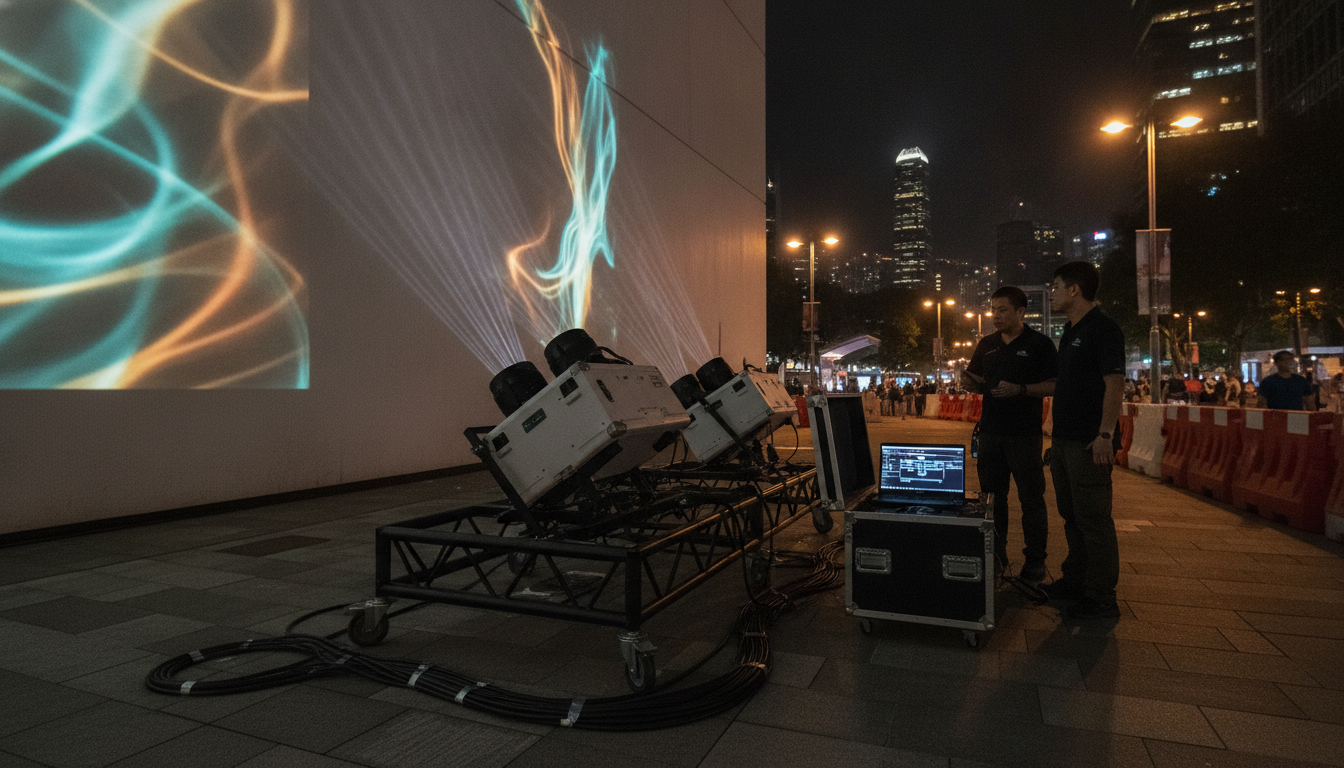
Ambient light raises the target lux, and it does so faster than most clients expect. Contrast is what makes an image look bright, and contrast is the ratio between the projected level and the light already falling on the wall. If street lighting and signage put 60 lux of spill on a surface, a 100-lux image gives you a 1.7 to 1 ratio, which reads as a faded wash regardless of how strong the content is.
The practical fix is to walk the site at the hour the show will run and meter the wall. A ballroom at a gala dinner, a harbourfront promenade with a lit skyline behind it, and a covered plaza at 8pm are three completely different problems even when the wall is the same size.
Where metering is not possible yet, the bands below are the targets we open with. They are deliberately conservative, because a show that is only just bright enough at rehearsal looks weak once the crowd, the phone screens and the catering lights arrive.
| Scene | Indicative ambient on wall | Target on-surface lux | Notes |
|---|---|---|---|
| Blacked-out indoor stage | Under 5 lux | 80 to 100 | Lowest cost per square meter |
| Dimmed ballroom or gala | 10 to 30 lux | 120 to 150 | Meter with the room set for dinner |
| Outdoor at night, no signage | 5 to 20 lux | 100 to 150 | Moonlight and distant spill only |
| Harbourfront or busy street at night | 30 to 80 lux | 150 to 250 | Signage and shopfronts dominate |
| Dusk or daylight | 300 lux and above | Not viable | Use LED wall at P2.84 instead |
What is screen gain and why does the wall surface matter?
Screen gain describes how much light a surface sends back toward the viewer compared with a perfect diffuse white. Matte white paint sits near 1.0. Raw dark concrete, dark render and unpainted brick commonly sit between 0.4 and 0.6, which means a 15,000-lumen projector delivers roughly what a 6,000 to 9,000-lumen unit would deliver on white.
Surface color matters as much as gain. A warm beige wall pushes the whole image toward yellow, so content needs a color correction pass and the projector needs calibration against the actual surface rather than a studio monitor. Stained, dusty or patched render creates uneven gain across the wall, which shows up as blotches in a gradient even when the projector is perfectly uniform.
Glass is its own problem. Most of the light passes through or reflects at a grazing angle, so mapping a clear curtain wall from outside is a losing fight unless the surface is treated. Rear projection from inside, or a purpose-built projection surface in front of the facade, are the usual answers. This is exactly the kind of thing a survey settles before any creative work starts.
Does throw distance make a projector dimmer?
Distance on its own does not dim a projector. What dims an image is area: the same lumens spread across a larger image means fewer lux per square meter. Move a projector twice as far and zoom to a lens that keeps the image the same size, and brightness stays broadly the same. Make the image bigger and it gets dimmer in direct proportion.
Distance does cost you in lens choice and light path. Long-throw lenses on large-venue projectors give up a few percent of output, and a beam crossing 60 meters of humid Hong Kong air picks up visible scatter, which reads as haze rather than loss. Throw ratio is distance divided by image width: a 30 meter wide wall seen from 60 meters needs roughly a 2.0 to 1 lens, and that calculation, not brightness, usually decides which projector goes on the truss.
Keystone correction is the other hidden tax. Every degree of electronic correction throws away pixels and softens edges, so on a mapping job we move the truss or use lens shift instead. A tilted projector that has been digitally squared up will always look softer than one that is physically square to the wall.
- Throw ratio locked against the measured distance and the required image width
- Lens shift used before keystone, so the unit can sit off-axis without losing resolution
- Beam path checked for haze, foliage, marquees and passing vehicles
- Blend overlap of 10 to 15 percent of image width between adjacent units
- Service access for a technician to reach every unit during the show
Why is a 15,000-lumen laser projector the working standard?
Fifteen thousand lumens is not a marketing figure, it is the size that fits the work. One unit covers about 100 square meters at 150 lux, which is the scale of most entrance features, podium walls, stage backdrops and mid-rise side walls in Hong Kong. Two of them, blended, handle the 250 square meter jobs that come up most often.
The laser-phosphor light source is what makes the class practical for events. Output holds far more consistently than a lamp projector across a long run, there is no lamp to change between build day and show day, and the units tolerate being rigged at steep angles. On a two-day build with a projector clamped at 40 degrees on a truss, that reliability is worth more than a small gain in headline lumens.
Above roughly 20,000 lumens the units get heavier, draw more power, need larger lenses and cost disproportionately more to rig and transport. Below 10,000 lumens you are usually blending two units where one would do, which adds a blend seam and a second point of failure. Where the wall is genuinely huge, we stack and blend mid-size units rather than specifying one enormous projector.
How do you check brightness before the event?
You check it with a meter on the wall, at the hour the show will run, with the venue lighting set to event level. Not on a laptop, and not at midnight with the house lights off if the event starts at seven.
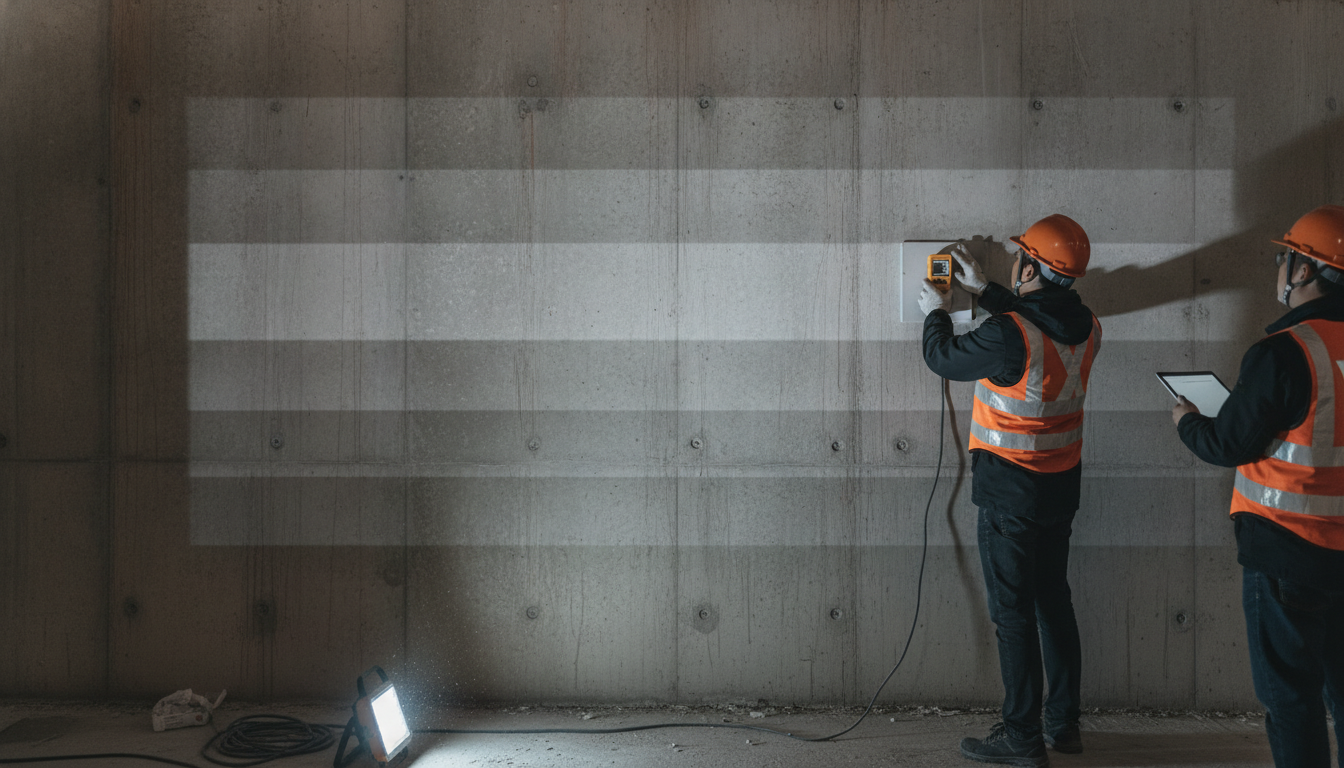
A five-point reading, four corners and center, of a white test pattern gives you the real lux spread and shows whether the corners are falling away. Projectors lose 20 to 30 percent of output at the corners of a zoomed image, and blending a second unit does not repair a hot center on the first one.
Then run the actual content rather than the test pattern. Saturated deep blues and reds read darker than white, so a wall measuring 150 lux on white can still look thin on a midnight blue gradient. If the rehearsal exposes that, the fix is either a higher target or a content grade, and both are far cheaper before the build than after.
What does more brightness cost?
Event projector rental in Hong Kong runs roughly HK$2,000 to HK$3,000 per unit per day depending on model and lens. The projector is rarely the largest line item once you need more than two of them, because each extra unit drags truss, weatherproof housing, cabling, blend calibration and crew time along with it.
A three-projector blended array is not three times the cost of a single unit. In labor and rigging terms it is often closer to four times, and that gap widens when the venue limits build hours or access. Budget the array, not the projector.
Where a client wants a large bright surface on a tight budget, an LED wall at P2.84 is sometimes the cheaper answer: it is bright by default, needs no throw distance, no blending and no dark room. The trade-offs are panel count, structure weight, and the fact that the wall has to be built rather than aimed. If the surface is architectural and irregular, projection still wins. You can see how both approaches look on real jobs in our portfolio.
What are the most common brightness mistakes?
Almost every brightness failure we see on site traces back to one of the items below. None of them are exotic, and all of them are cheaper to fix in a planning spreadsheet than on a build night.
- Specifying a projector before measuring the wall, then discovering the surface is dark render at 0.5 gain
- Comparing lumen figures between units without comparing lens, image area and corner falloff
- Metering the wall at midnight instead of at the hour the event actually runs
- Ignoring content color, so a saturated show looks dim even when the white test pattern measured well
- Using keystone correction to square up a tilted projector instead of moving the rig
- Assuming a wall is white when it is yellowed, patched or dusty, which costs 20 percent or more of the output
Frequently asked questions
How many lumens do I need to project on a 10 meter by 5 meter wall?
That is 50 square meters. At a night-time target of 150 lux on a matte surface you need about 7,500 lumens, so one mid-range laser projector will do it. If the wall gets significant signage spill, raise the target to 200 lux and you are at 10,000 lumens plus headroom.
Is 5,000 lumens enough for projection mapping?
Only in a dark room on a small surface. Five thousand lumens gives about 50 lux across 100 square meters, which is too dim for an outdoor Hong Kong night with street lighting. Indoors, on 30 to 40 square meters with the room blacked out, it is workable.
Does a brighter projector always look better?
No. Past the point where the image overwhelms ambient light, extra output mostly blows out highlights and flattens color. The goal is contrast against the surroundings, not the highest possible lumen number.
Why are the corners of a projected image dimmer than the center?
Lens falloff. A zoomed projector typically loses 20 to 30 percent of its output toward the corners, so the edges of a large image read darker. Blending a second unit can fill the gap but cannot repair a hot center on the first one.
How much does projector rental cost in Hong Kong for an event?
Roughly HK$2,000 to HK$3,000 per unit per day depending on model and lens, before rigging, cabling, blending and crew. A blended array costs noticeably more than the sum of its projectors because of the labor around it.
Can I use a home cinema projector for an outdoor projection mapping event?
Generally no. Home units lack the output, the long-throw lens options and the weather protection, and they are not built to run for hours in humid outdoor conditions. The result is usually a dim image that dies in the second hour.
Send us the wall dimensions, the venue and the event date, and our production team will come back with a projector count, a rigging outline and the lux target we would plan against. Ask for a brightness and projector plan.